
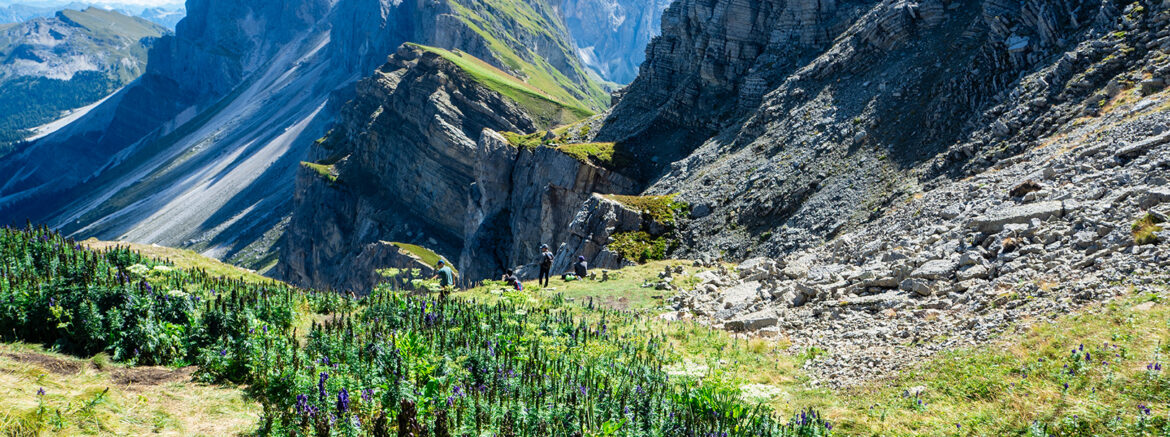
The Dolomites are not just any mountain range; they are a visual spectacle unmatched in Europe. Imagine beautiful green alpine meadows, with jagged, vertical rock formations rising hundreds, sometimes even thousands of meters above the ground in the background. This UNESCO World Heritage Site in the Italian Alps offers a beauty that is difficult to put into words. Anyone who loves rugged nature photography has undoubtedly seen these peaks on Instagram or in travel magazines. It is a destination that you must experience with your own eyes at least once in your life.
What makes the Dolomites so unique is the cultural fusion. Although you are in Italy, the area feels Austrian in many ways. This is due to the turbulent history of the South Tyrol region. The inhabitants are anything but typically Italian; you see a mix of Alpine traditions and Mediterranean flair. Think of the strict organization, wooden chalets, and spotless mountain huts that you know from Austria, but combined with refined Italian cuisine and an abundance of sunshine. With more than 300 sunny days a year, this is one of the sunniest areas in the Alps, making it an absolute top location in both summer and winter.
Table of Contents
- The Main Tourist Centers: Where to stay?
- Accommodations and advance reservations
- Costs and Budget: How much does a trip to the Dolomites cost?
- Transportation: How do you get around between the sights?
- Highlights you shouldn’t miss
- The Taste of the Dolomites: A Culinary Adventure
- Dolomiti Superski: The Largest Ski Area in the World
- Culture and History: Castles and Museums
- Expert Gear Guide: What to bring?
- Hiking with Children and the Magic of the Rifugio
- Essential Hiking Routes for Your First Trip
- How to get there
- The Ultimate Dolomites Checklist: What to pack?
- Frequently Asked Questions (FAQ)


The Main Tourist Centers: Where to stay?
Because the Dolomites cover such a vast area, it is impossible to see everything in one vacation. For a first trip, we recommend focusing on one of the main tourist centers. During our first few times traveling to the Dolomites, we only stayed at Santa Cristina (one of the picturesque villages within Val Gardena), only later on we stayed at the other areas. Below, we discuss the best bases for your adventure.
1. Val Gardena: The heart of the action
For a first vacation, the Val Gardena (Gröden) region is highly recommended. The valley consists of three main villages: Ortisei (St. Ulrich), Santa Cristina, and Selva (Wolkenstein). We stayed in Santa Cristina ourselves, which was a fantastic choice. The big advantage of Val Gardena is its infrastructure; from the villages, you can hop on the lift to the highest peaks.
From here, you can easily reach the Alpe di Siusi (Seiser Alm), a breathtaking alpine plain on a huge plateau. With the overwhelming peaks of the Langkofel and Plattkofel in the background, this is a paradise for hikers and photographers. Another absolute must in this valley is the hike at Seceda and Col Raiser. The view from the Seceda ridge, with the sloping rock faces sticking out of the earth like knives, is one of the most iconic images of the region.
2. Cortina d’Ampezzo
Cortina d’Ampezzo is located on the eastern side of the Dolomites. This village is the perfect base for those who want to tick off the most famous sights. From here, you can quickly reach the Tre Cime di Lavaredo (Three Peaks), the three iconic mountain peaks that symbolize the region. Other highlights such as the rock towers of Cinque Torri, the spectacular Passo Giau, and the turquoise Sorapis Lake are also within easy reach.
3. Alta Badia: The culinary paradise
Between Val Gardena and Cortina d’Ampezzo lies Alta Badia, a region known for its exceptionally high quality of life and food. This valley is home to Ladin culture, an ancient population group with its own language and unique traditions.
For the active traveler, Alta Badia is a dream. It offers direct access to the Sella massif and the famous Piz Boè. In winter, the village of Corvara is the beating heart of the region, but in summer, the area transforms into a quieter, luxurious retreat. What really sets Alta Badia apart is the “A Taste for Skiing” (and hiking) initiative, in which star chefs create menus for the simple mountain huts. So here you can eat at Michelin-star level with your hiking boots still on!
4. Val Pusteria and Bruneck
In the north, you will find the wide Val Pusteria. The most important town here is Bruneck (Brunico), an atmospheric place that often feels more like a ‘real’ town than the smaller mountain villages. It is the perfect base if you like variety: one day you can be standing on the top of Kronplatz, the next day you can be hiking along the shores of Lago di Braies.
Thanks to the wide valley, traveling here is often a little easier and less steep than deep in the mountains. This also makes it a popular region for cyclists and families who want to visit the famous sights, but also want the luxury of a larger city with shops and museums within easy reach. We especially learned to love this place because of the many swimming pools for our kids to enjoy. Another absolute highlight is hiking within the Fanes-Sennes National Park (entering through San Vigilio).


Which region suits you best? A quick comparison
To help you make the final choice for your first stay, we have compared the four most important regions. Each valley has its own character and strengths.
| Characteristic | Val Gardena | Cortina d’Ampezzo | Alta Badia | Val Pusteria |
| Atmosphere | Cosy, sporty & traditional | Sophisticated, luxurious & “see and be seen” | Culinary paradise & Ladin authenticity | Spacious, accessible & versatile |
| Iconic sights | Seceda & Alpe di Siusi | Tre Cime & Cinque Torri | Sella Massif & Piz Boè | Lago di Braies & Kronplatz |
| Best for… | First-time travelers and families | Photography and rugged rock peaks | Foodies and culture lovers | Variety, cycling, and convenience |
| Language | German, Italian, and Ladin | Mainly Italian | Ladin and Italian | Mainly German |
| Lift infrastructure | Excellent (modern and fast) | Good, but sometimes scattered | Very well connected | Excellent (especially Kronplatz) |
Accommodations and advance reservations
Finding the right accommodation in the Dolomites is an art in itself. The area is immensely popular and the best places are often fully booked months, sometimes even a year, in advance.
At least 6 months in advance
We’ve noticed that the more popular places are often fully booked and the only way to make a successful reservation is to be in time. Like 6 months in time or even earlier. We usually visit the Dolomites in our Dutch summer holiday period, which is the month of July and August. A few times we only started looking for a place to stay around April/May and everything and I mean everything was already fully booked.
The 7-Night Rule
Something that many travelers encounter is the strict booking culture. In popular tourist centers, many owners (especially of apartments) require a minimum stay of 7 nights, usually from Saturday to Saturday. If you try to book for 4 or 5 nights, you will often find that requests are rejected or that people wait to agree in the hope that someone will book for the full week. Want certainty? Then plan a stay of at least a week.
Our personal experience is that one full week per ‘base of operations’ is perfectly fine in the Italian Dolomites. Choose a wise strategic location and from there you can do trips within an hour of travel. In some cases we even choose our accommodation right next to a lift, so we don’t have to rely on our car. If you don’t have a car available, make sure to book something near a bus stop as public transport is very popular in this region.
The “Repeater” Culture
In the Dolomites, you will see something that is not as prevalent elsewhere: the right of previous guests. Many families book their room for the same time the following year as soon as they leave. We have experienced this ourselves at our favorite spot, Damont Apartments on Monte Pana. Only when regular guests cancel does the accommodation become available to new travelers. This sometimes makes it difficult to find something through sites like Booking.com; contacting the accommodation directly is definitely worthwhile here.


Costs and Budget: How much does a trip to the Dolomites cost?
The Dolomites are not a budget destination, but you can control costs by making smart choices. Here is a realistic overview of the expenses you should take into account (based on prices for 2026).
1. Accommodation
Finding proper accommodations will be your biggest expense. Often, even slightly older accommodations are still quite expensive in the summer months (in terms of price versus quality).
- High season (July/August/Winter): €1,500 – €2,500 per week for a family apartment in Val Gardena or Alta Badia. Outside of these popular areas we often find very nice places for prices below €1,000.
- Low season (June/September): €800 – €1,200 per week.
- Outside the hotspots: In villages just outside the main valleys (such as near Chiusa, Brixen or deeper in Val Pusteria), you can often find something for €700 to €1,000 per week.
Expert tip: We noticed that the ‘outer ring’ of the Dolomites often have very nice accommodations for competitive prices. As we usually don’t mind having to drive up to one hour max to reach our hiking start, we sometimes get a strategic but affordable place right outside to main touristic spots. The only downside is that we do miss the stunning mountain views when waking up in the morning, but having a place in peak season for less than €1,000 leaves a lot of budget for other fun stuff.
2. Lifts and Transportation (The hidden costs)
Don’t underestimate the cost of the lifts. A return trip to a peak such as Seceda can easily cost €40 to €45 per person.
- The Gardena Card: If you’re going to be doing a lot of hiking, this is your best friend. For around €100 to €130 (for 3 or 6 days), you have unlimited access to all lifts in Val Gardena.
- Toll roads: The famous road to the Tre Cime (Rifugio Auronzo) now costs €30 per car.
- Parking: At popular spots such as Lago di Braies, you pay between €15 and €20 per day. In the villages near the lift stations, you can expect to pay €5 to €10 per day.
Check lift prices up front and prepare your hiking routes based on these prices. Some lifts are much cheaper than others. Usually we take the lift up and then do a full day hike down. This means a one-way lift instead of return and often we take the cheapest lift available.
Want to save a lot? Go hiking instead of taking the lifts. Many beautiful huts are also accessible via well-marked trails from the valley. It will cost you more sweat and time, but it can save a family of four as much as €150 in a day. In addition, the tap water in the Dolomites is of excellent quality; fill your water bag at the countless free wooden water sources that you will find in every village and along many trails.
3. Food and Drink
Prices in mountain huts are often reasonable compared to the quality you get.
- Lunch in a Rifugio: For a hearty main course (such as Knödels or a plate of pasta), you’ll pay between €12 and €18.
- Drinks: An espresso often costs only €1.50 to €2.00 (even at high altitudes!). A glass of Hugo or Aperol Spritz costs between €6 and €9.
- Dinner: In a local restaurant in the valley, a three-course meal including wine will cost you around €40 to €60 per person.
We often bring along a few health bars, some nuts and a few sandwiches and have our lunch near one of the Rifugio’s. We don’t end up spending €100+ on our lunch, but instead have drinks and a small snack only (we often just share a plate of Kaiserschmarrn).
4. Groceries
The local DESPAR supermarkets are only slightly more expensive than the large hypermarkets in the rest of Europa, but the quality of the fresh produce is high. For a family of four who cooks for themselves, you can expect to spend around €150 to €200 per week on groceries, including the indispensable bread service of a few euros per day.
We often plan at least one day visit to Bolzano as this just is such a wonderful city, and this is often combined with a visit to one of the bigger supermarkets. We often also visit these bigger supermarkets on our arrival day, like the big MPREIS in Brixen.
Transportation: How do you get around between the sights?
The Dolomites are easily accessible, so if possible, go there with your own transport.
The Car vs. The Bus
Although a car is convenient for getting there, we recommend leaving it behind as much as possible once you arrive. Parking at the popular lifts is expensive and the roads can be very busy during the high season. In Val Gardena, many accommodations offer a free bus pass (Mobil Card). This allows you to travel easily between villages such as Ortisei and Selva.
The Gardena Card: A must for hikers
Lift tickets are expensive. A few rides to the top can easily cost tens of euros per person. If you plan to do a lot of hiking, the Gardena Card (available for 3 or 6 days) is essential. This pass gives you unlimited access to most lifts in the valley. Please note: this is different from the Passo Gardena, the mountain pass that you can drive over by car.
Highlights you shouldn’t miss
Seceda and the Odle group
If you take the lift to Seceda from Santa Cristina or Ortisei, you will be treated to world-class views. The sharp peaks of the Odle (Geisler) group seem to shoot up almost vertically from the green meadows here. The hike from Seceda to Col Raiser is one of the most beautiful hikes you can do, with constant “postcard views.”
One of our favorite hikes is the one that starts at the top station of Seceda and from there you walk all the way to Pieralongia, followed by lunch at Regensburgerhütte and then down to the Col Raiser lower station. Alternatively, you can take the lift to Col Raiser (top station), walk to the Fermedes lift and then get up to Seceda. The hike starts with some crowds, but quite soon it will be just you and perhaps a handful of others along the way.
Alpe di Siusi (Seiser Alm)
Imagine a rolling green plateau covering no less than 57 square kilometers, surrounded by the impressive peaks of the Sassolungo and Schlern. The Alpe di Siusi is not only a natural wonder, but also a place of absolute tranquility (because the plateau is largely car-free). It is the perfect spot for those famous sunrise photos, with mist rolling over the meadows as the first rays of sun hit the mountain peaks. You can reach the plateau by cable car from Ortisei or Siusi. It is perfect for a leisurely walk or a bike ride on an e-mountain bike.
We rented an e-mountain bike and this was a terrific way to explore the whole plateau. Walking is nice as well, but being on a bike is a whole other dimension. Tip: Try and rent it at Siusi as it will be much cheaper there compared to renting it at Alpe di Siusi.


Lago di Braies
This lake is spectacular, but also a victim of its own success. A circular hiking route runs along the lake, with stunning views from multiple angles. However, hiking towards Malga Foresta is great fun as well (no crowds there and the perfect place for a quiet lunch).
Important for your planning: in high season, the road to the lake is closed to private traffic during the day. You must reserve your parking space or shuttle bus weeks in advance online via the region’s official website. If you arrive without a reservation, you will be turned away.
Cinque Torri
Near the Passo Falzarego you will find the Cinque Torri. These are five enormous, freestanding rock formations that point towards the sky like fingers. It is a surreal landscape that is popular with both climbers and hikers. This area was an important front during the First World War. You can walk through restored trenches and bunkers (the Open Air Museum), which contrasts impressively with the natural beauty. Go at the end of the afternoon when the shadows of the towers over the rocky landscape are at their most beautiful.
Passo Giau: The most beautiful mountain pass in the Alps
Many travelers visit the Dolomites just for the lakes and hikes, but Passo Giau is a highlight in itself. It connects Cortina d’Ampezzo with Val Fiorentina and offers breathtaking 360-degree views. The striking peak of Ra Gusela watches over the pass. It is one of the most photographed mountain peaks in the world, especially during the blue hour. With 29 hairpin bends, the drive up is a dream for any driver or motorcyclist, but be prepared for the altitude (2236 meters); even in summer, it can freeze here.
Lago di Carezza
Lago di Carezza (Karersee) is located in the Val d’Ega. This lake is known for its surreal emerald green color and the perfect reflection of the Latemar massif in the water. Local Ladin legend has it that a wizard dropped a rainbow into the lake, hence its nickname Lec de Ergobando. One of the absolute highlights of this place is walking the Labirinto del Latemar, where you will end up back at Lago di Carezza. This one ranks high in our greatest hiking routes of the Dolomites, though it is not a long hike, it goes through so many stunning landscapes.
Update 2026: Since the great storm in 2018 (Vaia), the forest around the lake has partially disappeared, providing a dramatic and open view of the mountains. A modern visitor platform has been built to protect the fragile ecosystem.


The Taste of the Dolomites: A Culinary Adventure
One of the biggest surprises for first-time visitors to the Dolomites is the quality of the food. Forget the standard “burgers and fries” found in many ski resorts. In South Tyrol, food is a serious business. The cuisine reflects the region itself: a hearty Alpine base with a refined Italian finish.
Typical Dishes: Knödel and More
Anyone who sits down at a mountain hut (Rifugio) cannot ignore the Canederli (Knödel). These bread balls are a local specialty. The most popular varieties are Canederli agli spinaci (with spinach) and Canederli al formaggio (with local mountain cheese). They are often served in a rich broth or with melted butter and sage. Another dish you will encounter everywhere is Speck. This is not just any ham; it is smoked and seasoned according to centuries-old recipes. Be sure to visit Metzgerei Gruber in Ortisei or Il Maso Dello Speck in Selva for the best authentic products.
Aperitif culture: The Birthplace of the Hugo
Did you know that the popular Hugo cocktail originated in this region? This refreshing drink made from elderflower syrup, prosecco, mint, and a slice of lemon is the ultimate terrace drink after a long hike. Not a fan of elderflower? Then the Aperol Spritz is, of course, the undisputed alternative.
Dolomiti Superski: The Largest Ski Area in the World
Although summer is beautiful, in winter the Dolomites transform into a white paradise. And not just any paradise. With 1,200 kilometers of slopes and 450 lifts, Dolomiti Superski is the largest contiguous ski area in the world. What makes it unique is that you can explore this enormous area with just one ski pass.
The Sella Ronda
The absolute highlight for skiers is the Sella Ronda. This is a ski tour that takes you around the massive Sella massif. You cross four different valleys (Val Gardena, Val di Fassa, Arabba, and Alta Badia) without ever taking the same slope twice. The route is about 40 kilometers long and offers constant views of the jagged, snow-covered rock peaks.
For Every Level
While advanced skiers can indulge themselves on the World Cup descent of the Saslong, the Alpe di Siusi is the perfect place for beginners and families. The gentle slopes are wide and sunny, ideal for learning to ski in an accessible way while the children enjoy themselves in the many children’s areas.
Culture and History: Castles and Museums
The Dolomites are more than just nature; over the centuries, man has also left his mark in spectacular fashion.
The Guardians of the Valleys: Castles
Mysterious forts and castles can be seen everywhere on the ridges. Castel Wolkenstein, built against a vertical rock face, and Castel Prösels are definitely worth a visit. They are reminders of a time when these valleys were strategic passageways between northern and southern Europe.
Messner Mountain Museum (MMM) Corones
At the top of Kronplatz (Plan de Corones) at an altitude of 2275 meters, you will find an architectural masterpiece by world-renowned architect Zaha Hadid. This museum was founded by mountaineering legend Reinhold Messner. It is partly built into the mountainside and offers unparalleled views of the Dolomites. The museum tells the story of traditional mountaineering and is a must for anyone interested in the relationship between humans and mountains.
Messner Mountain Museum (Sigmundskron Castle Bolzano)
Located within the ancient walls of Sigmundskron Castle near Bolzano, MMM Firmian serves as the headquarters and centerpiece of Reinhold Messner’s museum project. The exhibition, titled “The Enchanted Mountain,” explores the profound relationship between humans and the peaks through art, installations, and historical relics. Beyond mountaineering, the “White Tower” documents the castle’s 1,000-year history and its significance as a symbol of South Tyrolean autonomy. Modern steel and glass architecture blends seamlessly with the ruins, offering a dramatic setting and panoramic views of the Adige Valley.


Expert Gear Guide: What to bring?
In the Dolomites, you can immediately see who is well prepared. The weather is treacherous, and good gear makes the difference between a dream vacation and a painful experience.
Shoes: The Basis of Everything
Never buy your mountain boots a week before departure. We have sworn by the Hanwag brand for years. For lighter trails, the Haglöfs
L.I.M. Low is an icon, but for the rougher work at the top of the mountains, the Hanwag Tatra II Wide GTX (also available in a wide version) offers the necessary support. Combine this with the X-SOCKS Trek outdoor socks (low rise ones); it may sound exaggerated, but good socks prevent blisters more effectively than any plaster.
Clothing: The layer system
In the mountains, we always work with layers.
Base layer: Breathable underwear from, for example, Saxx Droptemp Cooling Mesh and Odlo base shirts. This wicks away sweat and keeps you dry.
Mid layer: A fleece or sports shirt (e.g., from Patagonia R1 Air) for insulation.
Shell layer: A breathable but water- and windproof jacket. Even on a sunny day, it can suddenly get windy or cool on top of the Seceda. I used to wear a Haglöfs L.I.M. shell, but have recently moved on to a Norrøna falketind Gore-Tex Jacket.
Car essentials
Because we often stay in apartments outside the village center (such as on Monte Pana), we always bring a few “extras” in the car to make your stay more enjoyable:
- Your own Nespresso machine: Many apartments only have an old-fashioned filter coffee machine.
- A powerful power bank (65W): For use in the car and during long day trips to keep phones and cameras charged.
- Drone (with warning): Our DJI Mini 3 Pro always comes along for unique angles, but be warned: flying is not allowed in most nature parks. Check the D-Flight app for the current rules to avoid fines.
- Electric fly swatter: Where there are cows, there are flies. In an apartment on a mountainside, this is not a luxury, but a necessity.
Hiking with Children and the Magic of the Rifugio
A vacation in the Dolomites is ideal for families, provided you approach it wisely. With small children, you can’t expect them to walk for hours on end just for the view. Fortunately, that’s not a problem in the Dolomites, because the “reward” is never far away.
The Role of the Rifugio
Along almost every hiking trail, you will find a Rifugio (mountain hut) every few hundred meters. These are often full-fledged hotels and restaurants with huge sun terraces. For children, these are paradises: most huts have large playgrounds, sandboxes, and trampolines. While you enjoy a Kaiserschmarrn or a good espresso, the kids will have a great time.
Our favorites:
- Sanon Hütte: For the most iconic view of the Langkofel.
- Malga Contrin: An authentic place with delicious food.
- Rossalm: Right at the end of the famous Woody Walk.
- Geisleralm: The perfect place (reward) for hiking the Adolf Munkel Trail.
- Jimmi Hut: Great place near Grödner Joch and the path towards it even allows for strollers.
- Brogleshütte: Great Rifugio along the Resciesa loop hike.
Creativity on the Trail
Hiking with children in the mountains requires creativity. Come across a stream? Chances are the kids will entertain themselves for an hour building a dam. Use the many playgrounds along the way as “checkpoints.” A simple hike may take three times as long with children, but the memories are priceless.
Essential Hiking Routes for Your First Trip
If you are visiting the Dolomites for the first time, there are a number of routes that you simply cannot miss. These trails offer the most “value” per kilometer walked.
The Seceda to Col Raiser (Val Gardena)
After taking the lift from Ortisei to the top of Seceda, you will find yourself right on the famous ridge. The walk down to Col Raiser is relatively easy and takes you past several mountain huts (such as the Sophie Hütte and the Daniel Hütte). You will be walking with your back to the impressive Odle peaks the entire time.
The Tre Cime Loop (South Tyrol)
This is the king of hikes. The route around the three peaks is about 10 kilometers long and fairly flat.
- Parking tip: Drive early to the toll road at Misurina. The parking lot at Rifugio Auronzo (the starting point) is often full before 8:00 a.m.
- The route: Walk counterclockwise towards Rifugio Locatelli. From there, you have the famous view of the three north faces.
Raschötz Panorama Walk
From Ortisei, you can take the Panorama funiculare Raschötz (a small train that climbs up the mountain face). At the top, at an altitude of 2200 meters, you will find a flat walking area with a 360-degree view of the four defining mountains of the region: the Sella, the Marmolada, the Langkofel, and the Schlern. This is one of the most relaxing places in the region.
Adolf Munkel Trail
The Adolf Munkel Trail is one of the most spectacular paths in the Dolomites, running directly beneath the towering north faces of the Odle (Geisler) group. Starting from Zannes in Val di Funes, the trail offers a relatively easy hike that rewards you with “in-your-face” views of jagged limestone needles. It is famous for its incredible biodiversity, leading you through fragrant pine forests and lush alpine meadows filled with wildflowers. Along the way, the Malga Geisler hut provides the perfect stop to enjoy local South Tyrolean delicacies with the mountains as your backdrop. This route is an absolute must for photographers seeking that iconic shot of the Geisler peaks rising vertically from the grass.


How to get there
The Dolomites are surprisingly easy to reach, whether you choose to travel by car, train, or plane.
By car
Most people choose to travel by car. You will arrive either from the north (Innsbruck over Brenner) or from the south (Milano/Verona). A popular route for us Dutchies is via Germany (A7 or A3) towards the Brenner Pass.
- Please note: You need a vignette for Austria if you arrive through this route. Order this online in advance to avoid any hassle at the border.
- Electric driving: There are more than enough fast chargers along the highways in Germany and Austria. In the Dolomites themselves, you will also see more and more charging points at the valley stations of the lifts.
Flying and Train
Want to get there faster? Then fly to Innsbruck. From there, it’s only a 1.5-hour drive to Val Gardena by taxi or rental car. An alternative is to fly to Verona (2.5-hour drive). For the adventurous traveler, the night train to Innsbruck or Munich is a sustainable and relaxing alternative. From there, you can take the Flixbus or a rental car into the mountains.
The Ultimate Dolomites Checklist: What to pack?
In addition to your hiking boots and clothing, there are a number of items that we always carry in our daypack:
- 3-liter water bag: Much more convenient than individual bottles when traveling with a family.
- Sunscreen and cap: The sun at an altitude of 2,500 meters is merciless, even when it feels cool.
- Cash: Although you can use your debit card in 95% of places, the system in the mountains sometimes fails due to poor connection. Make sure you always have €50 in cash with you for that one mountain hut.
- Hiking maps or offline maps: The local tourist offices sell detailed maps. Google Maps often does not work on top of the mountain due to a lack of 4G/5G coverage. Take photos of the route maps at the parking lots in advance.
- Poles: Hiking poles are not for old people, they are very important accessories during hikes.
- First Aid Kit: Bring along the basics, just to be on the safe side.
- Rain coat or poncho: If it rains, it often pours. But even better, make sure you’re not deep in the mountains when dark clouds come in.
Frequently Asked Questions (FAQ)
Are the Dolomites more expensive than Austria? Yes, generally speaking. Accommodation and lift passes in the tourist centers are particularly pricey. However, you get a unique culinary experience and more hours of sunshine in return.
Can you visit the Dolomites without hiking? Absolutely. Thanks to the excellent lifts and well-maintained mountain passes (such as the Passo Gardena and Passo Sella), you can reach the most beautiful views without taking a step. Cities such as Bolzano and Bruneck also offer plenty of entertainment at the bottom of the valley.
When is the best time for a first trip? June through September for the summer. Keep in mind that the villages are very busy in July and August. September is often the most beautiful month: stable weather, less crowds, and the autumn colors are starting to show.
[…] met mooie bergen op de achtergrond houdt, heeft ze vast wel eens langs zien komen. De Dolomieten liggen in de Italiaanse Alpen en deze schitterende bestemming zou je wat mij betreft absoluut een keer moeten zien en […]